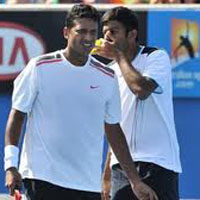
Talukdar, 27, is an experienced archer and took India to World No. 1 in 2011, along with Rahul Banerjee and Tarundeep Rai.
Deepika, 19, is looking for competitive experience to perform in keeping with her talent and rating at the international level. She went into London Olympics 2012 as World No. 1 and crashed out of the individual event, cracking under the weight of expectations.
“We were demoralised after the sports ministry refused to recognise the Archery Association of India (AAI). The junior archers were not getting jobs. I thank OGQ for this initiative,” said Talukdar. Deepika, who recently returned from the Archery World Cup Stage 1 in Shanghai with two silver medals including one with Jayanta, spoke about not repeating mistakes while preparing for Rio.
India ‘A’ went down fighting 1.5-2.5 to Germany in the final round as Russia won the Tata IBCA Chess Olympiad here on Sunday.
Little has changed over the four years as gold, silver and bronze went to the same identical nations, Russia, Ukraine and Spain in a repeat of 2008.
What has changed in the four years is that India ‘A’ has improved from its previous best showing of 16th to fifth place this time. In the 25-team competition, India ‘B’ managed 18th.
Russian had earlier won this event six times as Soviet Union. In the 14 times it has been staged, Poland has won once and the erstwhile Yugoslavia twice.
Swapanil Shah lost to Oliver Mueller with the black pieces. The Other Indians, Kishal Gangolli, Darpan Inani and Ashvin Makwana drew their matches.
Gangolli (7.5/9) of India ‘A’ won the individual gold medal for best performance on board three. He also remained undefeated winning six games and drawing three.
India won five matches, lost three and drew one.
The All India Chess Federation for the blind organised this event for the first time in Asia. Sports Minister Ajay Maken distributed the prizes.
The results (round nine): UK lost to Russia 1-3; Germany bt India ‘A’ 2.5-1.5; Spain bt Poland 2.5-1.5; Ukraine bt Serbia 3.5-0.5; India ‘B’ drew with Turkey 2-2.
Final placings: 1 Russia 15; 2-4. Ukraine, Spain, Germany 14 each; 5 India ‘A’ 11; 6-9. Poland, UK, Venezuela, Croatia 10 each; 18 India ‘B’ 8.
In the build up to London Olympics, it looked like that it would be their best Olympic Games for India ever. But then India started off their campaign on a sad note and the high profile Indian archery team made an early exit, Abhinav Bindra failed to qualify for the finals and Indian hockey as usual started with a loss, making it seem like bettering the Beijing performance would be a myth.
But then Gagan Narang broke the shackles and won India its first medal at the 10 m air rifle event. Thereafter, India made a slow but steady progress and doubled its medal haul from Beijing. Though it was nowhere close to the meadl tally of top sporting nations, nevertheless, it was commendable.
Even though India saw some upsets like Ronjan Sodhi, Abhinav Bindra, Deepika Kumari to name a few, the medal tally at London does indicate at the times to come. India never was a force to reckon to when it came to Olympics, but then this might well be the start.
From 1952 to 1996, India failed to win an individual medal at Olympics and it was Leander Paes who broke the jinx by winning a bronze at Atlanta. Following that, India returned with medal in every edition. The achievements at Beijing Olympics, where they won three individual medals including a gold, did instill a sense of optimism in India and the country started to take Olympic sports rather seriously.
Prior to Beijing, India entered the Olympic arena just for the sake of participation and no one even expected much from the athletes. But then that outlook has changed and it was all due to the achievements at Beijing Olympics. India entered London to win and the result shows that. It might not be that great as compared to other nations but then it is a start. There always was a social stigma engulfing the Indians about taking to Olympic sport but then it has been erased. Seeds of this self confidence were sown back in 2004 with the silver medal win by Rajyavardhan Singh Rathore and this Olympic might very well see a new sporting India arise.
Performance in Beijing also made the corporate to come forward and lend their support to the athletes. Private bodies like Mittals Champions Trust and Olympic Gold Quest are working efficiently to make the country a sporting nation. If Beijing created an opening, London surely has taken few paces in order to bridge the gap and in coming Olympics in Rio, a lot can be expected from the Indian athletes.
Indian medallist at London:
Sushil Kumar (silver in wrestling), Vijay Kumar (silver in shooting), Gagan Narang (bronze in shooting), Mary Kom (bronze in boxing), Saina Nehwal (bronze in badminton) and Yogeshwar Dutt (bronze in wrestling)
Mahesh Bhupathi and Rohan Bopanna have entered the finals of the ATP Cincinnati Masters after defeating Croatia's Ivan Dodig and Brazil's Marcelo Melo 6-4, 6-3.
The Indian pair with a straight set win is just one step away from winning the $2,825,280 hard court event. Both Bhupathi and Bopanna looked in complete control and never gave their opponent a chance to come back into the match.
They will now face the fourth seeded pair of Sweden’s Robert Lindstedt and Romania's Horia Tecau.
It will be the Indian pair’s second ATP win if they manage to win the tournament.
Another exercise of chasing a chimera is on. The dismay over the deplorable show by the hockey team in the Olympics is being deflected for the umpteenth time to a committee that is expected to solve the tangle of governance.
The Indian Olympic Association, which authored this mess in 2008, now comes up with a three-member commission to determine who among the claimants — Hockey India or Indian Hockey Federation — will administer the sport.
Painful exercise
To go back to the genesis of the crisis is a painful exercise. If K.P.S. Gill and his associates were guilty of failure in India not retaining its Olympic spot and deserved to be replaced, the scenario now is no less different.
The IOA, then under the command of Suresh Kalmadi, invoked the vague clause “disrepute to the game,” and disaffiliated the IHF. It constituted an ad hoc body, and then created Hockey India, fully aware of its legal and constitutional infirmities. The IOA hoped it would brazen it out with the opposition that cried foul of ignoring the canons of democracy. The Delhi High Court ruled against the disaffiliation.
It is difficult to imagine that the IOA, which has a slew of problems to solve, will disband Hockey India for the inglorious London campaign. Such recourse will receive spontaneous approbation. Hockey India’s record of administration is nothing to speak of with any degree of eloquence.
Tragically perhaps the International Hockey Federation, misled and misinformed, acted in haste.
Cover-up mode
Unable to retract, it ventured into a cover-up mode, raising various issues with the IHF over the failure of the merger from 2000 but continued dealing with the same office-bearers till 2008. How the three-member commission will untangle the imbroglio is a million-dollar question. All previous efforts, including that by the Sports Ministry, met with a dead-end after generating hopes of an accord.
What probably prompts the FIH to direct the IOA for a final decision could be related to India’s commitment to hosting the World Series League. If the FIH believes that a solution will be on the table on August 31, it is hovering in illusions.
A quick-fix remedy to a problem that has eaten away the vitals of Indian hockey for four years is unlikely to be found on one day (August 21).
The three-member commission may have no option but to recommend another ad hoc panel. If pushed to that edge, the IOA-team should keep the officials from both factions out of such a panel. The IOA can even think of forming an advisory committee enlisting members from outside its ambit, inviting senior lawyers and industrialists who share a love for hockey, to end this endemic national malaise. IOA’s urgency underlines a hint of desperation. Is it not time for the factions to realise the damage they have done to the national sport? They will earn the gratitude of all if a formula, embracing the frame-work of democracy, is framed and implemented quickly to extinguish the flames of acrimony, mistrust and egoism.
The 37-year-old Laxman, who been one of the mainstays for Indian batting lineup for test cricket for over years now felt it was the right time for him to retire and his retirement with immediate effect means he will not be playing the upcoming two test match series against New Zealand.
“I would like to announce my retirement from international cricket with immediate effect. I think it is the right time to move on”, Laxman said at a press conference here.
Laxman made his test debut in 1996 and since then has played 134 tests and scored 8781 runs including 17 centuries and 56 fifties. He has also played 86 ODIs scoring 2338 runs with six hundreds.
Laxman who will be remembered for his epic innings of 281 against Australia in 2001 at Eden Gardens and earned the sobriquet ‘Very Very Special’ said that the decision was a very hard one but then felt it was the right time to hang his boot and allow the youngsters to come into the team.
“I have always kept my country’s success and need ahead self. And while I would love contributing to the team’s success, especially against England and Australia, I think this is the right to give opportunity to the youngsters in home conditions ahead of international assignments”, he said.
“It was a dream for me to play for India since childhood and I am extremely thankful to the Almighty for giving me the opportunity to serve my country,” added the Hyderabadi.
On being asked whether he would regret the decision later, he said, “I never regret the decisions I take. I am satisfied with the decision, definitely I will never regret that I took the decision“.
Laxman who came under criticism due to poor run in England and Australia last season said it did disappoint him as well whenever he failed to live up to the expectations.
“I always tried to my best to give everything to the team while maintaining my dignity. There were times I am sure I did not perform well, I disappointed them but I can assure that it was not due to lack of effort,” he said.
“There have been people who have criticised me but I had more well wishers. I can tell you that it is not easy to please each and every person. Failure and success are part and parcel of a cricketer’s life”, he explained.
Laxman however conceded that he will continue playing for Hyderabad and is still undecided on his post retirement life.
The Times Of India. "It (hosting of FIFA U-17 World Cup) will be a big boost for Indian football and give players and all the coaches a lot of motivation to work even harder to ensure that we have a competitive team," said Scott O'Donnell, who is the All India Football Federation's (AIFF) Technical Director of Academies and Director of Coach Education.
In case India hosts the event, the national Under-17 squad would get a direct entry into the tournament.
Meanwhile a DNA report says that the All India Football Federation (AIFF) technical director (academies), Scott O’Donnell, is in the city to conduct the 15th batch of the AIFF ‘D’ Licence course along with the federation’s Technical Director Rob Baan and AIFF instructors from Maharashtra’s state association WIFA. It began on August 13 and ends on August 19 at the Cooperage Football Ground.
The main aim for O’Donnell, who is also the director of coach education of AIFF, and AIFF technical director Rob Baan is to reach out to youngsters at the grassroots level. The regional academies are the key word stressed by the duo. O’Donnell is aware that there is a lot of work to do at grassroots and academies.
He believed that one must not go by the FIFA ranking. “FIFA rankings are self explanatory. Too much importance is given to rankings. And, if you win a couple of games against higher ranked teams, there will be a drastic change in your standing,” he said.
Yogeshwar fought back strongly in the repechage rounds to notch up three successive victories in the space of less than an hour to provide India its fifth medal at the London Games and the first on the mat.
The 29-year-old from Sonepat in Haryana, who had missed a medal four years ago at the Beijing Olympics, showed excellent technique and fighting spirit to bring off three memorable wins on the trot for the bronze.
In the repechage rounds, in which he had to beat three opponents, Yogeshwar started off with a win over World Championship runner-up Franklin Gomez Matos of Puerto Rico and followed it with another brilliant victory over Iran's Masoud Esmaeilpoorjouybari to be one win away from a medal.
The two victories that came within the space of 20 minutes got Yogeshwar's adrenaline going and he brought off another stupendous come from behind victory over his North Korean rival to fetch the bronze.
In the all-important medal round, Yogeshwar started on a wrong foot conceding a point to his strong North Korean rival, who seemed to have the upper hand initially.
However, the tide changed drastically in favour of the Indian in the next period in which he took a point to draw level with Myong Ri and leave the stage set for a dramatic finish.
But as things turned out, Yogeshwar was at the height of his prowess in the final period which saw him score a staggering six technical points in a jiffy to seal the issue in his favour.
Using all his experience and technique to the fullest, Yogeshwar managed to pull Myong Ri down on the mat, and then rolled him over a few times to lay claim on the well-deserved bronze, which he has been yearning for the past four years.
Yogeshwar earlier fought off the challenges from Matos and Esmaeilpoorjouybari, winning 3-0 and 3-1 respectively, to be in the contention for the bronze medal.
The Haryana grappler got lucky against Matos, winning the toss on both the occasions to earn a clinch position, which the experienced grappler, in his third Olympics, converted to the best of his capabilities.
With the score line reading 0-0 at the end of the first period, Yogeshwar got into the favourable position and was able to get one technical point, which was enough to gain the initial advantage.
Leuris Pupo from Cuba won the gold. Pupo also equalled the finals world record with 34. Vijay shot 28. Feng Ding from China won the bronze medal.
Vijay Kumar shoots silver medal in 25m Rapid Fire Pistol at London Olympics! India now have 2 medals at the 2012 London Olympics.
Vijay Kumar's eighth series: 2/5. TOTAL SCORE: 32/40
Vijay Kumar's seventh series: 4/5. TOTAL SCORE: 28/35
Another good news for India. Alexei Klimov
of Russia has been eliminated. The contest is now between just three players!
Vijay Kumar's sixth series: 4/5. TOTAL SCORE: 24/30
Good news for India. Jian Zhang from China has been eliminated.
Vijay Kumar's fifth series: 4/5. TOTAL SCORE: 20/25 He is now joint second, a silver medal position for the time being.
Christian Reitz from Germany has been eliminated!
Vijay Kumar's fourth series: 3/5. TOTAL SCORE: 16/20He is now joint second.
Vijay Kumar's third series: 4/5. TOTAL SCORE: 13/15 He is joint first with two other marksmen. Five more series to go!
Vijay Kumar's second series: 4/5. TOTAL SCORE: 9/10
Vijay Kumar's first series: 5/5
Marksman Vijay Kumar lifted the Indian shooting team`s spirit by qualifying for the final of the men`s 25m Rapid Fire Pistol event at the Olympic Games here today.
En route to his total score of 585, Kumar became the second shooter to break the previous Olympic record of 583 during the second stage of qualification.
Placed fourth in the list, Kumar, who had scored 293 in stage 1 of the qualification yesterday, shot a series of 98 97 97 in the second stage to take his total score to 585.
He shot a sequence of 99 96 98 at the Royal Artillery Barracks.
The Army man will be competing with five shooters for a medal.
Pre-Games medal favourite Ronjan Sodhi had yesterday failed to qualify for the double trap event.
Russian Alexei Klimov created a new world record by shooting 592.
He scored a total of 592 after Stage 2, breaking the existing world record of 591 and Olympic record of 583, with 294 points in Stage 1 and a staggering 298 out of 300 in Stage 2.
Ace Indian shuttler Saina Nehwal got a shot in the arm ahead of next month's Olympics as she lifted the Thailand Open Grand Prix Gold title after rallying to beat Thailand's Ratchanok Inthanon in the final of the event in Bangkok on Sunday. The 22-year-old world number five Indian beat
Inthanon 19-21 21-15 21-10 at the C U Sport Complex in Bangkok for her second title of the year after the Swiss Open win in March. The win will come as a massive boost to Saina's confidence ahead of Olympics in July-August. The top seeded Indian was scratchy to start with but drew from her experience and superb maneuvering at the net to beat her second-seeded 17-year-old rival.
Although it was a see-saw battle to start with, Inthanon's energy and fabulous baseline play stood out. The smash winner, which is Saina's stock shot, was coming out more frequently from the Thai's racquet who seemed to revel amid the partisan crowd's thunderous cheering.
Inthanon, ranked 11th in the world, grabbed a 10-7 lead after Saina's attempted smash landed outside the court and the teenager, to whom Saina had lost in the Sudirman Cup last year, made it 16-10 in no time.
At that point, Saina was struggling to match up to the Thai's sheer athleticism and swiftness on the court. In fact, most of the points that Saina notched up during the game were courtesy the errors committed by Inthanon instead of standout shots by the Indian.
The gap kept widening in favour of the Thai, whose spectacular speed in covering all ends on the court was commendable. Down 12-19, Saina staged a recovery of sorts making it 17-19 as Inthanon had an attack of nerves which led her to commit a few unforced errors.
She ended up wasting a game point by stroking one into the net but egged on by a vocal coach and vociferous home supporters, she managed to clinch the game on Saina's serve.
Saina was clearly the better of the two at net but it was Inthanon's seven smash winners against the Indian's one which made the decisive difference in the game.